Ticket to Ride
LumiScore
Growth
46/100
Growth Value
- Problem Solving
- Spatial Awareness
- Strategic Thinking
Risk
LOW
Engagement Patterns
Minimal pressure to spend or play excessively.
Heads up
Parent Pro-Tip
Encourage children to discuss their strategies and decisions while playing to deepen their critical thinking skills. Remind them that losing is part of the game and to focus on the fun of strategic planning and adapting to challenges.
Top Skills Developed
Development Areas
Representation?How diverse the game's characters are in gender and ethnicity. Higher = more authentic representation. Display only — does not affect time recommendation.
Bechdel Test?The Bechdel Test checks whether a game has at least two named female characters who talk to each other about something other than a man. A simple measure of representation.— N/A — no named characters
Ticket to Ride is an abstract strategy board game adaptation with no narrative characters, male or female.
What your child develops
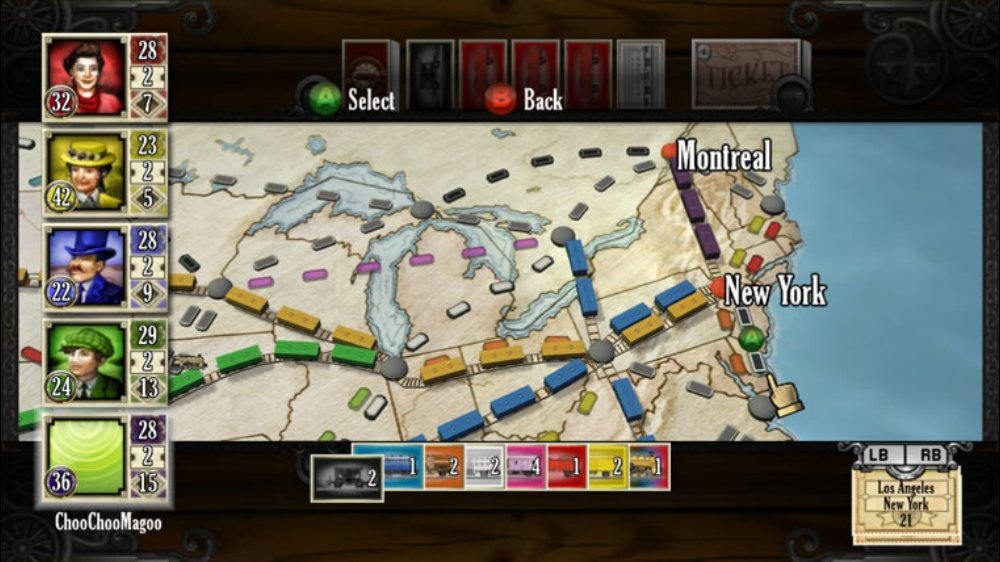
Ticket to Ride strongly develops problem-solving, spatial awareness, strategic, and critical thinking by requiring players to plan routes, manage resources, and adapt to changing game conditions. It offers a mentally engaging experience, encouraging thoughtful decision-making to achieve victory and improve planning skills.
⚖️How this score was debate-reviewedShow transcript
Two AI models debated this score in 2 rounds: an Advocate arguing for the highest defensible scores, and a Critic arguing for the lowest. The final score averages their round-2 positions.
=== Round 1 ===

ADVOCATE (arguing HIGH):
B1: problemSolving=5, spatialAwareness=5, strategicThinking=5, criticalThinking=4, memoryAttention=5, creativity=3, readingLanguage=3, mathSystems=5, learningTransfer=4, adaptiveChallenge=4
B2: teamwork=0, communication=2, empathy=1, emotionalRegulation=3, ethicalReasoning=1, positiveSocial=3
B3: handEyeCoord=3, fineMotor=3, reactionTime=1, physicalActivity=0
R1: variableRewards=2, streakMechanics=0, lossAversion=2, fomoEvents=0, stoppingBarriers=0, notifications=0, nearMiss=1, infinitePlay=0, escalatingCommitment=2, variableRewardFreq=2
R2: spendingCeiling=1, payToWin=1, currencyObfuscation=0, spendingPrompts=1, childTargeting=1, adPressure=0, subscriptionPressure=0, socialSpending=0
R3: socialObligation=0, competitiveToxicity=1, strangerRisk=0, socialComparison=1, identitySelfWorth=1, privacyRisk=0
Reasoning: Ticket to Ride delivers exceptional cognitive development, with its core gameplay demanding high levels of strategic thinking, problem-solving, and spatial awareness to optimize routes and outwit opponents. The game further enhances memory and mathematical reasoning through intricate resource management and scoring. Despite its competitive nature, the digital board game fosters positive social engagement and emotional regulation in a structured environment. Crucially, Ticket to Ride presents minimal risks, boasting low scores for dopamine exploitation, monetization pressures, and social harms, making it a highly beneficial and safe strategic experience.

CRITIC (arguing LOW):
B1: problemSolving=4, spatialAwareness=3, strategicThinking=4, criticalThinking=4, memoryAttention=3, creativity=1, readingLanguage=2, mathSystems=2, learningTransfer=3, adaptiveChallenge=3
B2: teamwork=0, communication=0, empathy=0, emotionalRegulation=1, ethicalReasoning=0, positiveSocial=1
B3: handEyeCoord=1, fineMotor=1, reactionTime=0, physicalActivity=0
R1: variableRewards=2, streakMechanics=1, lossAversion=2, fomoEvents=0, stoppingBarriers=1, notifications=1, nearMiss=1, infinitePlay=0, escalatingCommitment=2, variableRewardFreq=2
R2: spendingCeiling=0, payToWin=0, currencyObfuscation=1, spendingPrompts=1, childTargeting=1, adPressure=0, subscriptionPressure=0, socialSpending=0
R3: socialObligation=0, competitiveToxicity=1, strangerRisk=0, socialComparison=1, identitySelfWorth=0, privacyRisk=0
Reasoning: The game receives minimal scores in social-emotional (B2) and motor skill (B3) domains due to its design. B2 scores are particularly low as the game lacks explicit interactive social mechanics, with no teamwork, communication features, or opportunities for narrative-driven empathy, as confirmed by "Stranger chat: No." Furthermore, as a turn-based digital board game, it offers negligible development for motor skills, requiring only basic hand-eye coordination for inputs and no real-time reactions or physical activity.


=== Round 2 ===

ADVOCATE (arguing HIGH):
B1: problemSolving=5, spatialAwareness=4, strategicThinking=5, criticalThinking=5, memoryAttention=4, creativity=1, readingLanguage=3, mathSystems=4, learningTransfer=4, adaptiveChallenge=4
B2: teamwork=0, communication=0, empathy=0, emotionalRegulation=2, ethicalReasoning=0, positiveSocial=1
B3: handEyeCoord=1, fineMotor=1, reactionTime=0, physicalActivity=0
R1: variableRewards=3, streakMechanics=1, lossAversion=3, fomoEvents=0, stoppingBarriers=1, notifications=1, nearMiss=2, infinitePlay=0, escalatingCommitment=3, variableRewardFreq=2
R2: spendingCeiling=0, payToWin=0, currencyObfuscation=0, spendingPrompts=1, childTargeting=1, adPressure=0, subscriptionPressure=0, socialSpending=0
R3: socialObligation=0, competitiveToxicity=2, strangerRisk=0, socialComparison=1, identitySelfWorth=0, privacyRisk=0
Reasoning: The critic's assessment profoundly underestimates the cognitive benefits of Ticket to Ride, a strategic board game adaptation that actively cultivates robust problem-solving, strategic thinking, spatial awareness, and mathematical reasoning. Players must meticulously plan routes, manage limited resources, and adapt to opponents' actions, fostering high-level critical thinking and learning transfer. While social and motor benefits are inherently limited by its turn-based nature, the game effectively mitigates major risks with no stranger chat, pay-to-win elements, or currency obfuscation. The engaging variable reward loops are intrinsic to competitive strategy games, driving sustained intellectual engagement rather than exploitation, and the limited social risks allow for healthy competition.

CRITIC (arguing LOW):
B1: problemSolving=5, spatialAwareness=5, strategicThinking=5, criticalThinking=4, memoryAttention=5, creativity=1, readingLanguage=3, mathSystems=5, learningTransfer=4, adaptiveChallenge=4
B2: teamwork=0, communication=0, empathy=0, emotionalRegulation=1, ethicalReasoning=0, positiveSocial=1
B3: handEyeCoord=1, fineMotor=1, reactionTime=1, physicalActivity=0
R1: variableRewards=2, streakMechanics=0, lossAversion=2, fomoEvents=0, stoppingBarriers=0, notifications=0, nearMiss=1, infinitePlay=0, escalatingCommitment=2, variableRewardFreq=2
R2: spendingCeiling=1, payToWin=1, currencyObfuscation=0, spendingPrompts=1, childTargeting=1, adPressure=0, subscriptionPressure=0, socialSpending=0
R3: socialObligation=0, competitiveToxicity=1, strangerRisk=0, socialComparison=1, identitySelfWorth=1, privacyRisk=0
Reasoning: The advocate's cognitive scores are mostly sound, acknowledging the game's strategic depth, but creativity is overblown for an optimization task. Social-emotional benefits (B2) are heavily inflated, as the game lacks interactive social mechanics, chat, or co-op required to actively develop communication, empathy, or positive social skills. The rubric explicitly limits positiveSocial for single-player games. Similarly, motor skill development (B3) is minimal in this turn-based game, justifying lower scores. Risk scores, however, appear appropriately assessed by the advocate given the game's characteristics.

=== Final (weighted 40% advocate / 60% critic, Round 2) ===
B1: problemSolving=5, spatialAwareness=5, strategicThinking=5, criticalThinking=4, memoryAttention=5, creativity=1, readingLanguage=3, mathSystems=5, learningTransfer=4, adaptiveChallenge=4
B2: teamwork=0, communication=0, empathy=0, emotionalRegulation=1, ethicalReasoning=0, positiveSocial=1
B3: handEyeCoord=1, fineMotor=1, reactionTime=1, physicalActivity=0
R1: variableRewards=2, streakMechanics=0, lossAversion=2, fomoEvents=0, stoppingBarriers=0, notifications=0, nearMiss=1, infinitePlay=0, escalatingCommitment=2, variableRewardFreq=2
R2: spendingCeiling=1, payToWin=1, currencyObfuscation=0, spendingPrompts=1, childTargeting=1, adPressure=0, subscriptionPressure=0, socialSpending=0
R3: socialObligation=0, competitiveToxicity=1, strangerRisk=0, socialComparison=1, identitySelfWorth=1, privacyRisk=0
Curascore: 58  BDS: 0.460  RIS: 0.227
Regulatory Compliance
Tap a badge for details. Grey = not yet assessed.
About this game
Ticket to Ride is a turn-based strategy game, an adaptation of a board game of the same name. ### Gameplay The gameplay copies the board game entirely.