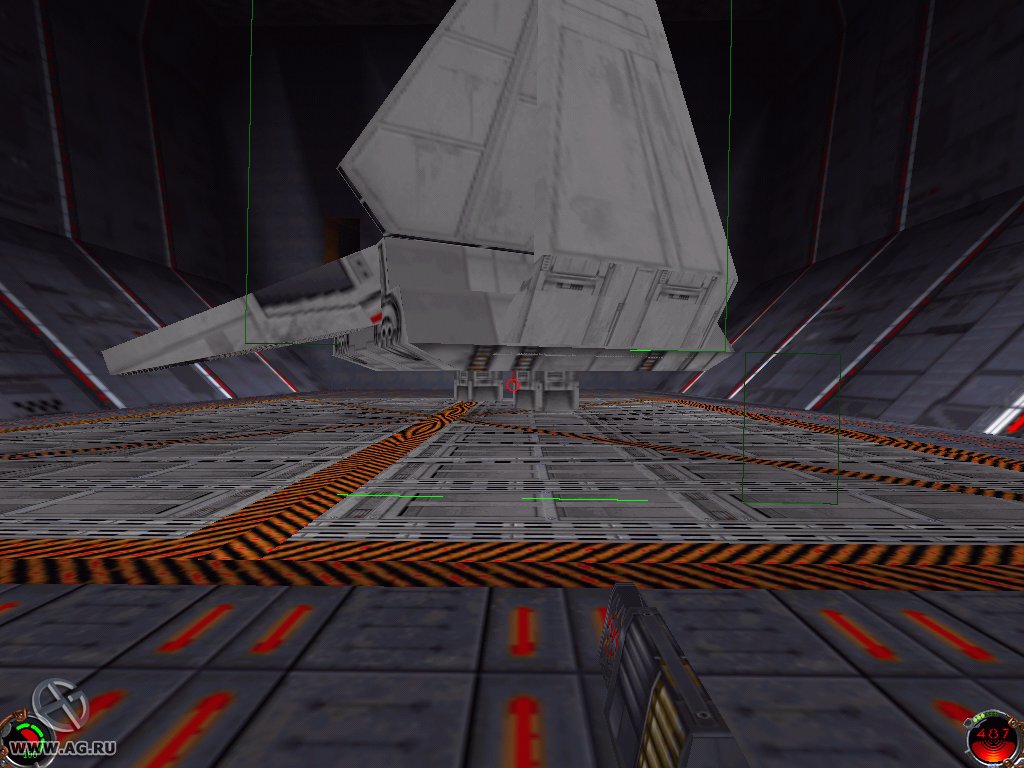
STAR WARS Jedi Knight: Dark Forces II
LumiScore
Growth
56/100
Growth Value
- Spatial Awareness
- Hand-Eye Coordination
- Reaction Time
Risk
LOW
Engagement Patterns
Minimal pressure to spend or play excessively.
Heads up
Parent Pro-Tip
Play the first few levels together to gauge whether the violence level is appropriate for your child before allowing independent play. If using multiplayer, stick to LAN or private sessions with known friends rather than open internet lobbies.
Top Skills Developed
Development Areas
Representation?How diverse the game's characters are in gender and ethnicity. Higher = more authentic representation. Display only — does not affect time recommendation.
Bechdel Test?The Bechdel Test checks whether a game has at least two named female characters who talk to each other about something other than a man. A simple measure of representation.— Fails the test
The game features named female characters Jan Ors and Sariss Jeng, but they do not directly interact with each other in the game's narrative.
What your child develops
Jedi Knight is a strong single-player action game that rewards spatial reasoning, environmental navigation, and reflex-based combat across varied 3D levels. The Force power system introduces light-side versus dark-side choices that give the game genuine ethical weight, and the branching ending encourages reflection on consequences. Level design demands memory, exploration, and moderate problem-solving to locate objectives and secret areas.
⚖️How this score was debate-reviewedShow transcript
Two AI models debated this score in 2 rounds: an Advocate arguing for the highest defensible scores, and a Critic arguing for the lowest. The final score averages their round-2 positions.
=== Round 1 ===

ADVOCATE (arguing HIGH):
B1: problemSolving=5, spatialAwareness=5, strategicThinking=5, criticalThinking=5, memoryAttention=4, creativity=3, readingLanguage=3, mathSystems=0, learningTransfer=5, adaptiveChallenge=5
B2: teamwork=3, communication=3, empathy=1, emotionalRegulation=2, ethicalReasoning=4, positiveSocial=2
B3: handEyeCoord=5, fineMotor=4, reactionTime=5, physicalActivity=0
R1: variableRewards=1, streakMechanics=0, lossAversion=1, fomoEvents=0, stoppingBarriers=0, notifications=0, nearMiss=1, infinitePlay=1, escalatingCommitment=1, variableRewardFreq=0
R2: spendingCeiling=0, payToWin=0, currencyObfuscation=0, spendingPrompts=0, childTargeting=0, adPressure=0, subscriptionPressure=0, socialSpending=0
R3: socialObligation=0, competitiveToxicity=2, strangerRisk=3, socialComparison=1, identitySelfWorth=1, privacyRisk=1
Reasoning: Jedi Knight: Dark Forces II offers exceptional cognitive benefits through its complex 3D environments, strategic combat requiring diverse Force power application, and critical decision-making on light/dark paths. Its first-person shooter mechanics inherently foster high hand-eye coordination, fine motor skills, and rapid reaction times. Furthermore, the explicit moral choices between the Light and Dark sides significantly promote ethical reasoning. The game presents minimal risk, scoring zero in all monetization categories due to the absence of modern manipulative tactics. While stranger chat in multiplayer introduces a notable social risk, it is largely offset by the game's strong developmental benefits and lack of other exploitative design.

CRITIC (arguing LOW):
B1: problemSolving=3, spatialAwareness=4, strategicThinking=3, criticalThinking=3, memoryAttention=3, creativity=1, readingLanguage=2, mathSystems=0, learningTransfer=3, adaptiveChallenge=3
B2: teamwork=1, communication=1, empathy=0, emotionalRegulation=0, ethicalReasoning=1, positiveSocial=1
B3: handEyeCoord=4, fineMotor=4, reactionTime=4, physicalActivity=0
R1: variableRewards=1, streakMechanics=0, lossAversion=0, fomoEvents=0, stoppingBarriers=0, notifications=0, nearMiss=0, infinitePlay=0, escalatingCommitment=1, variableRewardFreq=0
R2: spendingCeiling=0, payToWin=0, currencyObfuscation=0, spendingPrompts=0, childTargeting=0, adPressure=0, subscriptionPressure=0, socialSpending=0
R3: socialObligation=0, competitiveToxicity=2, strangerRisk=3, socialComparison=1, identitySelfWorth=1, privacyRisk=1
Reasoning: Despite offering multiplayer, social-emotional benefit scores (B2) are critically low because the game's core experience is a single-player narrative, and its competitive multiplayer does not inherently foster teamwork, communication, or positive social interactions. The ethical choices presented are narrative, not interactive social development. Furthermore, the game largely predates modern manipulative design, resulting in minimal R1 dopamine risks. Conversely, the confirmed presence of 'Stranger chat' in multiplayer necessitates high R3 social risk scores, particularly for stranger risk and potential competitive toxicity.


=== Round 2 ===

ADVOCATE (arguing HIGH):
B1: problemSolving=4, spatialAwareness=5, strategicThinking=4, criticalThinking=4, memoryAttention=4, creativity=2, readingLanguage=3, mathSystems=0, learningTransfer=4, adaptiveChallenge=4
B2: teamwork=2, communication=2, empathy=1, emotionalRegulation=1, ethicalReasoning=3, positiveSocial=1
B3: handEyeCoord=5, fineMotor=5, reactionTime=5, physicalActivity=0
R1: variableRewards=1, streakMechanics=0, lossAversion=0, fomoEvents=0, stoppingBarriers=0, notifications=0, nearMiss=0, infinitePlay=1, escalatingCommitment=1, variableRewardFreq=0
R2: spendingCeiling=0, payToWin=0, currencyObfuscation=0, spendingPrompts=0, childTargeting=0, adPressure=0, subscriptionPressure=0, socialSpending=0
R3: socialObligation=0, competitiveToxicity=3, strangerRisk=3, socialComparison=2, identitySelfWorth=2, privacyRisk=2
Reasoning: The game's robust 3D environments, complex combat, and explicit light/dark side choices provide rich cognitive and ethical development opportunities, justifying higher B1 and B2 ethical reasoning scores. While primarily single-player, the active multiplayer with 'stranger chat' significantly elevates B2 communication and teamwork potential, and B3 motor skills due to intense FPS demands. Minimal R1/R2 manipulative design remains true, supporting low scores in these areas. However, the direct online interaction and competitive nature necessitate higher R3 scores for competitive toxicity, stranger risk, and social comparison. This balanced view advocates for both the game's developmental benefits and its inherent online risks.

CRITIC (arguing LOW):
B1: problemSolving=5, spatialAwareness=5, strategicThinking=4, criticalThinking=4, memoryAttention=4, creativity=1, readingLanguage=3, mathSystems=0, learningTransfer=4, adaptiveChallenge=5
B2: teamwork=1, communication=1, empathy=0, emotionalRegulation=0, ethicalReasoning=4, positiveSocial=1
B3: handEyeCoord=5, fineMotor=4, reactionTime=5, physicalActivity=0
R1: variableRewards=2, streakMechanics=0, lossAversion=2, fomoEvents=0, stoppingBarriers=0, notifications=0, nearMiss=2, infinitePlay=2, escalatingCommitment=2, variableRewardFreq=1
R2: spendingCeiling=0, payToWin=0, currencyObfuscation=0, spendingPrompts=0, childTargeting=0, adPressure=0, subscriptionPressure=0, socialSpending=0
R3: socialObligation=0, competitiveToxicity=3, strangerRisk=3, socialComparison=2, identitySelfWorth=2, privacyRisk=1
Reasoning: While Jedi Knight: Dark Forces II offers strong motor skill development and commendable ethical reasoning through its narrative choices, the advocate significantly overestimates other benefits. Cognitive scores like creativity and learning transfer are inflated, as the game focuses on applying predefined systems rather than fostering genuine innovation or broad skill application. Social benefits (B2) are particularly exaggerated; a competitive multiplayer mode with chat does not automatically develop teamwork, communication, or positive social skills, nor does narrative empathy justify B2 scores. Furthermore, the inherent risks of competitive multiplayer with stranger chat, alongside common dopamine loops in action games, warrant higher R1 and R3 scores than initially proposed.

=== Final (weighted 40% advocate / 60% critic, Round 2) ===
B1: problemSolving=5, spatialAwareness=5, strategicThinking=4, criticalThinking=4, memoryAttention=4, creativity=1, readingLanguage=3, mathSystems=0, learningTransfer=4, adaptiveChallenge=5
B2: teamwork=1, communication=1, empathy=0, emotionalRegulation=0, ethicalReasoning=4, positiveSocial=1
B3: handEyeCoord=5, fineMotor=4, reactionTime=5, physicalActivity=0
R1: variableRewards=2, streakMechanics=0, lossAversion=1, fomoEvents=0, stoppingBarriers=0, notifications=0, nearMiss=1, infinitePlay=2, escalatingCommitment=2, variableRewardFreq=1
R2: spendingCeiling=0, payToWin=0, currencyObfuscation=0, spendingPrompts=0, childTargeting=0, adPressure=0, subscriptionPressure=0, socialSpending=0
R3: socialObligation=0, competitiveToxicity=3, strangerRisk=3, socialComparison=2, identitySelfWorth=2, privacyRisk=1
Curascore: 63  BDS: 0.560  RIS: 0.288
Regulatory Compliance
Tap a badge for details. Grey = not yet assessed.
About this game
Dark Forces™ set the industry standard for first person action in the Star Wars® universe. Now Jedi Knight: Dark Forces II picks up where the award-winning game left off...