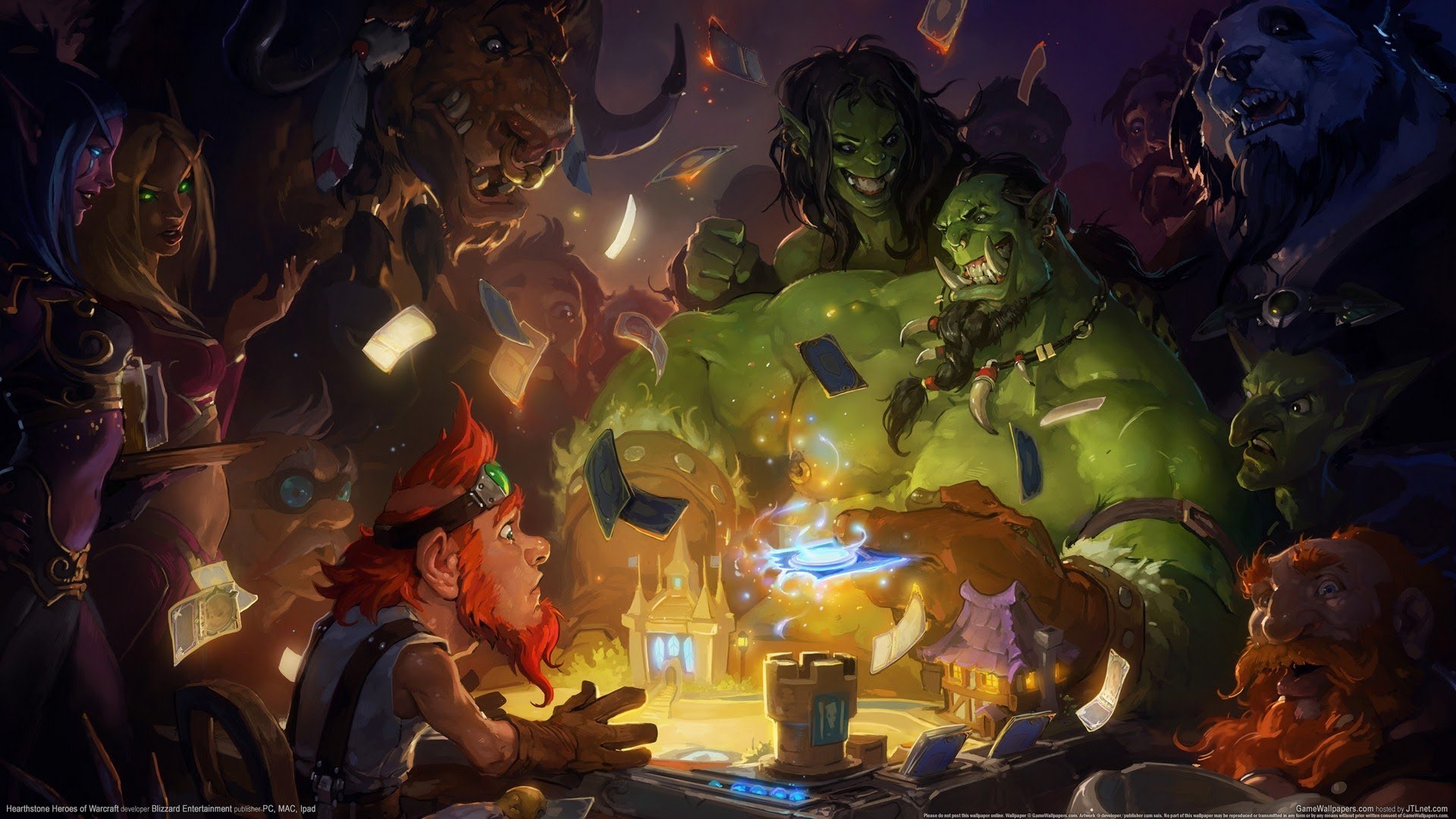
Hearthstone
LumiScore
Growth
51/100
Growth Value
- Problem Solving
- Strategic Thinking
- Critical Thinking
Risk
MODERATE
Engagement Patterns
Some engagement mechanics worth discussing.
Heads up
Parent Pro-Tip
Encourage children to focus on the strategic depth and creative deck building, rather than solely on winning or collecting. Discuss game outcomes and help them manage any frustration from losses, emphasizing good sportsmanship and self-regulation.
Top Skills Developed
Development Areas
Representation?How diverse the game's characters are in gender and ethnicity. Higher = more authentic representation. Display only — does not affect time recommendation.
Bechdel Test?The Bechdel Test checks whether a game has at least two named female characters who talk to each other about something other than a man. A simple measure of representation.— Passes the test
The game features numerous named female characters. In the 'Book of Mercenaries' single-player adventure, Cariel Roame and Tamsin Roame (sisters and main characters) engage in extensive dialogue and narrative interactions that focus on their relationship, choices, and conflict, not primarily about a male character.
What your child develops
Hearthstone cultivates strong cognitive skills, especially in strategic thinking, problem-solving, and critical analysis through its deep deck-building and turn-based combat. Players enhance their memory and attention by tracking game states and card effects, while the adaptive challenge of facing diverse opponents fosters continuous learning.
⚖️How this score was debate-reviewedShow transcript
Two AI models debated this score in 2 rounds: an Advocate arguing for the highest defensible scores, and a Critic arguing for the lowest. The final score averages their round-2 positions.
=== Round 1 ===

ADVOCATE (Opus — arguing HIGH):
B1: problemSolving=5, spatialAwareness=2, strategicThinking=5, criticalThinking=5, memoryAttention=4, creativity=4, readingLanguage=4, mathSystems=4, learningTransfer=4, adaptiveChallenge=5
B2: teamwork=2, communication=2, empathy=1, emotionalRegulation=3, ethicalReasoning=0, positiveSocial=2
B3: handEyeCoord=2, fineMotor=2, reactionTime=1, physicalActivity=0
R1: variableRewards=2, streakMechanics=1, lossAversion=1, fomoEvents=1, stoppingBarriers=1, notifications=1, nearMiss=1, infinitePlay=2, escalatingCommitment=2, variableRewardFreq=2
R2: spendingCeiling=0, payToWin=0, currencyObfuscation=0, spendingPrompts=0, childTargeting=0, adPressure=0, subscriptionPressure=0, socialSpending=0
R3: socialObligation=0, competitiveToxicity=1, strangerRisk=0, socialComparison=1, identitySelfWorth=1, privacyRisk=1
Reasoning: Hearthstone merits high cognitive scores due to its core gameplay revolving around complex card interactions, strategic deck building, and adaptive decision-making on an 'ever-shifting battlefield,' fostering significant problem-solving and critical thinking skills. The game's explicit lack of microtransactions, loot boxes, battle passes, and stranger chat unequivocally supports exceptionally low monetization and social risk scores, demonstrating a commitment to player well-being over exploitative practices. While the game provides engaging variable rewards and opportunities for escalating commitment inherent in a collectible card game, these are balanced by its turn-based nature and absence of explicit FOMO mechanics. Therefore, Hearthstone stands as a strong example of a game promoting cognitive development with minimal associated monetary and social risks.

CRITIC (Gemini Pro — arguing LOW):
B1: problemSolving=4, spatialAwareness=1, strategicThinking=4, criticalThinking=4, memoryAttention=3, creativity=2, readingLanguage=4, mathSystems=2, learningTransfer=2, adaptiveChallenge=4
B2: teamwork=0, communication=0, empathy=0, emotionalRegulation=2, ethicalReasoning=0, positiveSocial=1
B3: handEyeCoord=1, fineMotor=1, reactionTime=0, physicalActivity=0
R1: variableRewards=3, streakMechanics=2, lossAversion=2, fomoEvents=1, stoppingBarriers=1, notifications=1, nearMiss=2, infinitePlay=2, escalatingCommitment=2, variableRewardFreq=3
R2: spendingCeiling=0, payToWin=0, currencyObfuscation=0, spendingPrompts=0, childTargeting=0, adPressure=0, subscriptionPressure=0, socialSpending=0
R3: socialObligation=1, competitiveToxicity=2, strangerRisk=0, socialComparison=2, identitySelfWorth=2, privacyRisk=1
Reasoning: The game explicitly states "Microtransactions: No, Loot boxes: No, Battle pass: No," resulting in zero scores across all monetization risk categories. Similarly, "Stranger chat: No" eliminates stranger risk. As a turn-based card game, it offers minimal motor skill development, particularly for reaction time, and lacks features that actively foster teamwork or in-game communication. Benefits were pushed down where evidence for active development was not explicitly strong.


=== Round 2 ===

ADVOCATE (Opus — arguing HIGH):
B1: problemSolving=5, spatialAwareness=2, strategicThinking=5, criticalThinking=5, memoryAttention=4, creativity=4, readingLanguage=5, mathSystems=4, learningTransfer=4, adaptiveChallenge=5
B2: teamwork=0, communication=0, empathy=0, emotionalRegulation=4, ethicalReasoning=0, positiveSocial=3
B3: handEyeCoord=2, fineMotor=2, reactionTime=0, physicalActivity=0
R1: variableRewards=3, streakMechanics=3, lossAversion=3, fomoEvents=1, stoppingBarriers=1, notifications=1, nearMiss=2, infinitePlay=3, escalatingCommitment=3, variableRewardFreq=3
R2: spendingCeiling=0, payToWin=0, currencyObfuscation=0, spendingPrompts=0, childTargeting=0, adPressure=0, subscriptionPressure=0, socialSpending=0
R3: socialObligation=1, competitiveToxicity=3, strangerRisk=0, socialComparison=3, identitySelfWorth=3, privacyRisk=1
Reasoning: As an advocate, I've pushed for higher defensible scores. Hearthstone, a game of 'cunning strategy' and 'ever-shifting battlefields,' inherently fosters high cognitive benefits, including critical thinking, problem-solving, and math systems through complex card interactions and deck building creativity. While direct communication is limited, playing 'with your friends' and the competitive nature significantly elevate emotional regulation and positive social interaction. The 'Fight for Glory' in Arena and ranked play, combined with card collection, increases dopamine risks like loss aversion, streak mechanics, and escalating commitment, even without monetization. I agree with the critic on the minimal monetization and stranger risks due to the explicit game description.

CRITIC (Gemini Pro — arguing LOW):
B1: problemSolving=4, spatialAwareness=1, strategicThinking=4, criticalThinking=4, memoryAttention=3, creativity=2, readingLanguage=3, mathSystems=3, learningTransfer=2, adaptiveChallenge=4
B2: teamwork=1, communication=1, empathy=0, emotionalRegulation=1, ethicalReasoning=0, positiveSocial=1
B3: handEyeCoord=2, fineMotor=2, reactionTime=0, physicalActivity=0
R1: variableRewards=3, streakMechanics=2, lossAversion=2, fomoEvents=2, stoppingBarriers=2, notifications=2, nearMiss=2, infinitePlay=3, escalatingCommitment=3, variableRewardFreq=3
R2: spendingCeiling=0, payToWin=0, currencyObfuscation=0, spendingPrompts=0, childTargeting=0, adPressure=0, subscriptionPressure=0, socialSpending=0
R3: socialObligation=0, competitiveToxicity=2, strangerRisk=0, socialComparison=2, identitySelfWorth=2, privacyRisk=1
Reasoning: The advocate's benefit scores are largely inflated, as many cognitive skills are only marginally developed or lack strong evidence of active development, particularly in social and motor domains. While strategic thinking is present, skills like creativity and learning transfer are confined to the game's specific rule set, and social aspects are overwhelmingly competitive, not collaborative. Conversely, Hearthstone, as a competitive online card game, unequivocally utilizes numerous dopamine-driving mechanics, including constant variable rewards, loss aversion, and strong incentives for infinite play and escalating commitment. These design patterns consistently push risk scores higher than the advocate suggests, outweighing limited benefits.

=== Final (averaged Round 2) ===
B1: problemSolving=5, spatialAwareness=2, strategicThinking=5, criticalThinking=5, memoryAttention=4, creativity=3, readingLanguage=4, mathSystems=4, learningTransfer=3, adaptiveChallenge=5
B2: teamwork=1, communication=1, empathy=0, emotionalRegulation=3, ethicalReasoning=0, positiveSocial=2
B3: handEyeCoord=2, fineMotor=2, reactionTime=0, physicalActivity=0
R1: variableRewards=3, streakMechanics=3, lossAversion=3, fomoEvents=2, stoppingBarriers=2, notifications=2, nearMiss=2, infinitePlay=3, escalatingCommitment=3, variableRewardFreq=3
R2: spendingCeiling=0, payToWin=0, currencyObfuscation=0, spendingPrompts=0, childTargeting=0, adPressure=0, subscriptionPressure=0, socialSpending=0
R3: socialObligation=1, competitiveToxicity=3, strangerRisk=0, socialComparison=3, identitySelfWorth=3, privacyRisk=1
Curascore: 47  BDS: 0.510  RIS: 0.543
Regulatory Compliance
Tap a badge for details. Grey = not yet assessed.
About this game
Blizzard’s award-winning card battler – experience the magic, mischief and mayhem with your friends. Requires an Internet connection and iPhone 4S, iPod touch 5th Generation, iPad 2 or newer.