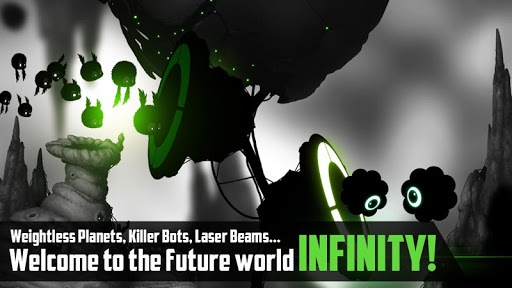
BADLAND 2
LumiScore
Growth
47/100
Growth Value
- Problem Solving
- Spatial Awareness
- Hand-Eye Coordination
Risk
MODERATE
Engagement Patterns
Some engagement mechanics worth discussing.
Heads up
Parent Pro-Tip
Encourage your child to focus on the satisfaction of mastering challenging levels rather than solely on leaderboard rankings. Discuss strategies for navigating complex environments and celebrate their progress in overcoming obstacles. This game is an excellent choice for developing reflexes and strategic thinking with minimal monetization or social interaction risks.
Top Skills Developed
Development Areas
Representation?How diverse the game's characters are in gender and ethnicity. Higher = more authentic representation. Display only — does not affect time recommendation.
Bechdel Test?The Bechdel Test checks whether a game has at least two named female characters who talk to each other about something other than a man. A simple measure of representation.— N/A — no named characters
BADLAND 2 features abstract, unnamed creatures and environmental puzzles, lacking named characters of any gender.
What your child develops
BADLAND 2 excels in fostering cognitive skills, particularly problem-solving, spatial awareness, hand-eye coordination, and reaction time, through its challenging physics-based levels. Players must critically analyze environments and adapt to new mechanics to progress, enhancing their learning transfer abilities. The game's intuitive controls make it accessible while providing a good workout for fine motor skills.
⚖️How this score was debate-reviewedShow transcript
Two AI models debated this score in 2 rounds: an Advocate arguing for the highest defensible scores, and a Critic arguing for the lowest. The final score averages their round-2 positions.
=== Round 1 ===

ADVOCATE (Opus — arguing HIGH):
B1: problemSolving=5, spatialAwareness=5, strategicThinking=4, criticalThinking=4, memoryAttention=4, creativity=2, readingLanguage=1, mathSystems=0, learningTransfer=4, adaptiveChallenge=5
B2: teamwork=0, communication=0, empathy=0, emotionalRegulation=1, ethicalReasoning=0, positiveSocial=2
B3: handEyeCoord=5, fineMotor=4, reactionTime=5, physicalActivity=0
R1: variableRewards=2, streakMechanics=1, lossAversion=2, fomoEvents=3, stoppingBarriers=1, notifications=2, nearMiss=3, infinitePlay=3, escalatingCommitment=2, variableRewardFreq=2
R2: spendingCeiling=0, payToWin=0, currencyObfuscation=0, spendingPrompts=0, childTargeting=0, adPressure=0, subscriptionPressure=0, socialSpending=0
R3: socialObligation=1, competitiveToxicity=2, strangerRisk=0, socialComparison=2, identitySelfWorth=1, privacyRisk=1
Reasoning: BADLAND 2 is a highly beneficial game, promoting significant cognitive and motor skill development. Its "deviously imaginative levels" and "physics-based gameplay" necessitate strong problem-solving, spatial awareness, and critical thinking to navigate complex, multi-directional environments. The intuitive two-touch controls demand exceptional hand-eye coordination and rapid reaction times for survival. Additionally, the continuously evolving challenges through new levels and online events foster adaptive learning, ensuring players constantly refine their abilities. Crucially, the game presents minimal risks, with no monetization and an absence of stranger chat.

CRITIC (Gemini Pro — arguing LOW):
B1: problemSolving=3, spatialAwareness=3, strategicThinking=1, criticalThinking=2, memoryAttention=3, creativity=0, readingLanguage=1, mathSystems=0, learningTransfer=2, adaptiveChallenge=3
B2: teamwork=0, communication=0, empathy=0, emotionalRegulation=0, ethicalReasoning=0, positiveSocial=0
B3: handEyeCoord=4, fineMotor=3, reactionTime=4, physicalActivity=0
R1: variableRewards=3, streakMechanics=0, lossAversion=2, fomoEvents=3, stoppingBarriers=2, notifications=2, nearMiss=2, infinitePlay=3, escalatingCommitment=3, variableRewardFreq=2
R2: spendingCeiling=0, payToWin=0, currencyObfuscation=0, spendingPrompts=0, childTargeting=0, adPressure=0, subscriptionPressure=0, socialSpending=0
R3: socialObligation=0, competitiveToxicity=2, strangerRisk=0, socialComparison=3, identitySelfWorth=2, privacyRisk=2
Reasoning: This game receives exceptionally low benefit scores for social skills (B2) and several cognitive (B1) domains, like creativity and mathematical systems, due to its primarily single-player, linear design. The asynchronous online challenges, while competitive, offer no direct social interaction, precluding any development of teamwork, communication, or empathy. Furthermore, the game explicitly lacks monetization, eliminating all associated financial risks (R2), and the absence of direct chat removes stranger risk and social obligation. The physical activity benefit (B3) is also absent, as the gameplay is entirely touch-based.


=== Round 2 ===

ADVOCATE (Opus — arguing HIGH):
B1: problemSolving=5, spatialAwareness=5, strategicThinking=4, criticalThinking=4, memoryAttention=4, creativity=0, readingLanguage=2, mathSystems=0, learningTransfer=4, adaptiveChallenge=5
B2: teamwork=0, communication=0, empathy=0, emotionalRegulation=0, ethicalReasoning=0, positiveSocial=0
B3: handEyeCoord=5, fineMotor=4, reactionTime=5, physicalActivity=0
R1: variableRewards=3, streakMechanics=0, lossAversion=3, fomoEvents=3, stoppingBarriers=3, notifications=3, nearMiss=3, infinitePlay=3, escalatingCommitment=3, variableRewardFreq=3
R2: spendingCeiling=0, payToWin=0, currencyObfuscation=0, spendingPrompts=0, childTargeting=0, adPressure=0, subscriptionPressure=0, socialSpending=0
R3: socialObligation=0, competitiveToxicity=3, strangerRisk=0, socialComparison=3, identitySelfWorth=3, privacyRisk=3
Reasoning: The game's "deviously imaginative levels" and "innovative physics-based gameplay" significantly challenge cognitive functions like problem-solving, spatial awareness, critical thinking, and adaptive challenge, pushing these benefits higher than the critic suggests. While social interaction is limited to asynchronous competition, the intense "intuitive two-touch controls" and dynamic environments necessitate maximal hand-eye coordination, fine motor skills, and reaction time. Furthermore, the constant "online events" and leaderboards, combined with the game's challenging nature, heighten dopamine loop risks such as loss aversion, near-miss effects, and notifications, even without explicit monetization. Finally, competitive elements against "strangers" on global leaderboards elevate social comparison, identity-self-worth risks, and potential competitive toxicity beyond the initial assessment. Privacy risk is also higher due to persistent online accounts and data syncing.

CRITIC (Gemini Pro — arguing LOW):
B1: problemSolving=5, spatialAwareness=5, strategicThinking=4, criticalThinking=4, memoryAttention=4, creativity=0, readingLanguage=1, mathSystems=0, learningTransfer=4, adaptiveChallenge=5
B2: teamwork=0, communication=0, empathy=0, emotionalRegulation=0, ethicalReasoning=0, positiveSocial=0
B3: handEyeCoord=5, fineMotor=4, reactionTime=5, physicalActivity=0
R1: variableRewards=2, streakMechanics=0, lossAversion=2, fomoEvents=3, stoppingBarriers=0, notifications=2, nearMiss=3, infinitePlay=3, escalatingCommitment=2, variableRewardFreq=2
R2: spendingCeiling=0, payToWin=0, currencyObfuscation=0, spendingPrompts=0, childTargeting=0, adPressure=0, subscriptionPressure=0, socialSpending=0
R3: socialObligation=0, competitiveToxicity=2, strangerRisk=0, socialComparison=2, identitySelfWorth=1, privacyRisk=1
Reasoning: While BADLAND 2 offers strong cognitive and motor benefits as a challenging side-scroller, several social and creative benefits are overstated. The game's linear design offers no avenues for creative expression, and its asynchronous competitive elements do not translate to genuine positive social interaction or active emotional regulation development. Furthermore, the description provides no evidence for certain dopamine-related risks like streak mechanics and stopping barriers, necessitating lower scores. However, risks associated with competitive social comparison, FOMO from online events, and the nature of infinite play are accurately reflected and defensible given the game's features.

=== Final (averaged Round 2) ===
B1: problemSolving=5, spatialAwareness=5, strategicThinking=4, criticalThinking=4, memoryAttention=4, creativity=0, readingLanguage=2, mathSystems=0, learningTransfer=4, adaptiveChallenge=5
B2: teamwork=0, communication=0, empathy=0, emotionalRegulation=0, ethicalReasoning=0, positiveSocial=0
B3: handEyeCoord=5, fineMotor=4, reactionTime=5, physicalActivity=0
R1: variableRewards=3, streakMechanics=0, lossAversion=3, fomoEvents=3, stoppingBarriers=2, notifications=3, nearMiss=3, infinitePlay=3, escalatingCommitment=3, variableRewardFreq=3
R2: spendingCeiling=0, payToWin=0, currencyObfuscation=0, spendingPrompts=0, childTargeting=0, adPressure=0, subscriptionPressure=0, socialSpending=0
R3: socialObligation=0, competitiveToxicity=3, strangerRisk=0, socialComparison=3, identitySelfWorth=2, privacyRisk=2
Curascore: 44  BDS: 0.470  RIS: 0.529
Regulatory Compliance
Tap a badge for details. Grey = not yet assessed.
About this game
The sequel to Apple’s Game of the Year -winning BADLAND with over 65 million players! Apple Editors' Choice worldwide!